

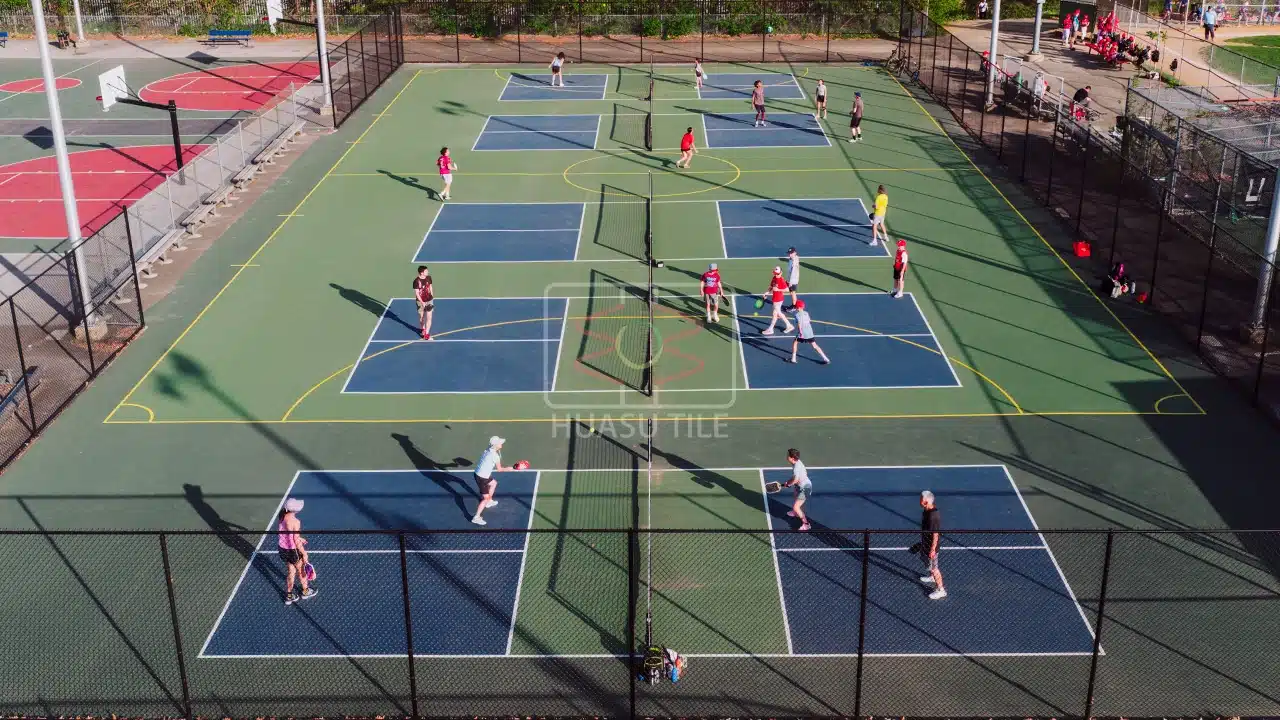
Commercial pickleball court tiles are attracting more attention as facilities plan new courts, but facility owners are becoming more selective about where and how they invest. The Sports & Fitness Industry Association reported that 24.3 million Americans played pickleball in 2025, while the number of core players—those who play at least eight times per year—reached 7.5 million. Read the 2026 SFIA report.
Market conditions can differ by location and facility type, so buyers should ask focused questions about site fit, durability, maintenance, and total project value.
For clubs, schools, contractors, community facilities, and sports venues, the right question is not simply, “Which pickleball court tiles are cheapest?”
Which court tile system fits the site, playing conditions, maintenance plan, and expected level of use?
This guide explains the main factors to evaluate before requesting a quote.
1. Match Commercial Pickleball Court Tiles to the Use Case
The best commercial pickleball court tiles for a backyard are not automatically the best choice for a club or school. Before comparing materials, define how the courts will be used.
- Indoor or outdoor installation
- Residential, community, school, club, or commercial use
- Expected daily playing hours
- Number of courts
- Recreational or tournament-oriented programming
- Single-sport or multi-sport use
- Permanent or occasionally reconfigured installation
- Local weather, heat, rainfall, and freeze-thaw conditions
- Available base, drainage, and site access
A facility with several courts and heavy daily use may prioritize long-term surface consistency, replacement support, maintenance access, and documented performance. A smaller recreational installation may place more emphasis on installation flexibility, appearance, and total project cost.
Defining the use case first prevents a common purchasing mistake: selecting a tile based on one attractive feature without checking whether the complete system fits the project.
2. Confirm the Court Area Before Ordering Tiles
The playing lines of a standard pickleball court measure 20 feet by 44 feet. However, the playing area needs additional space around the lines.
USA Pickleball’s construction guidance states that a total playing surface of 30 feet by 60 feet is the minimum recommended area, while 34 feet by 64 feet is preferred for new construction and tournament play. The organization also recommends a north-south orientation when possible to reduce the effect of sunlight in players’ eyes.
This distinction matters when calculating:
- Tile quantity
- Court spacing
- Safety zones
- Fencing location
- Lighting placement
- Access routes
- Drainage direction
- Space between multiple courts
Do not order a tile quantity based only on the 20-by-44-foot playing lines. A commercial court project needs to account for the complete playing surface and the surrounding installation area.
For multi-court facilities, prepare a site plan showing the number of courts, circulation paths, spectator areas, fencing, lighting, storage, and service access before finalizing the flooring order.
3. Evaluate the Base and Drainage System
Commercial pickleball court tiles are only one part of the playing surface. The base beneath them is equally important.
USA Pickleball identifies asphalt and concrete as acceptable bases for outdoor pickleball courts, while also emphasizing the importance of slope, drainage, surface finish, and construction specifications.
Before selecting commercial pickleball court tiles for an outdoor facility, ask:
- Is the existing base level and structurally sound?
- Is the surface free from major cracks, settlement, or movement?
- Where will rainwater go?
- Does the site need perimeter or subsurface drainage?
- Will water collect beneath or around the tile system?
- Are expansion joints, transitions, and edges properly addressed?
- Does the tile supplier have written base requirements?
Perforations or drainage openings in a tile do not solve every drainage problem. Water still needs a suitable route away from the court. A tile system installed over an unsuitable base can experience movement, unevenness, edge problems, or premature wear.
For a new facility, coordinate the tile supplier, civil contractor, and court installer early. For a renovation, inspect the existing slab or asphalt before requesting a final flooring quote.
4. Compare Modular Tiles With Acrylic Court Surfacing
Modular pickleball court tiles and acrylic surfacing systems solve different project requirements.
Modular tiles may be attractive when a project needs:
- A panel-based system
- Flexible court configurations
- Easier access to individual damaged sections
- A distinct visual design
- A solution for an existing hard base
Acrylic surfacing may be preferred when the project requires:
- A continuous coated surface
- Traditional hard-court construction
- A specific coating and color system
- A new or resurfaced asphalt or concrete court
- A surface approach aligned with existing tennis or outdoor court standards
USA Pickleball recommends 100% acrylic coatings for pickleball and athletic courts when properly applied. That does not mean acrylic is automatically the right answer for every facility, nor does it mean every modular tile system offers the same playing characteristics.
For a commercial pickleball court tiles project, the correct comparison should include:
- Ball response
- Surface traction
- Player comfort
- Drainage behavior
- UV and weather exposure
- Base compatibility
- Installation process
- Repair and replacement method
- Cleaning requirements
- Expected maintenance cycle
- Total installed and operating cost
A credible supplier should explain where its system fits and where another surface type may be more appropriate.
5. Look Beyond “PP” or “TPE” on the Specification Sheet
Material labels are useful, but they are not enough to choose a commercial court surface.
Polypropylene, commonly identified as PP, and thermoplastic elastomer, commonly identified as TPE, can appear in different system designs. The final playing experience depends on more than the material name.
Ask for details about:
- Tile thickness
- Tile dimensions
- Locking or connection structure
- Surface texture
- Cushioning components
- Edge and transition pieces
- Color options
- Line-marking method
- Drainage and ventilation design
- Replacement procedure
- Applicable test reports
- Product-specific limitations
For a commercial project, request the exact product model and the corresponding technical documentation. Avoid accepting a general statement about a material as proof of performance for every product in a supplier’s catalog.
6. Require Evidence for Performance Claims
A supplier may describe a court tile as durable, weather resistant, comfortable, non-slip, or suitable for heavy use. Those statements should be evaluated against evidence.
For each important performance claim, ask:
- What product model does the test cover?
- What test method was used?
- Was the testing performed on the complete system or only one material?
- Does the result apply to indoor, outdoor, or both environments?
- What installation conditions are required?
- Are there exclusions for the base, climate, chemicals, or maintenance?
- Is the evidence current and available for review?
The most important evidence categories may include ball rebound or playability, surface friction or traction, shock absorption, UV exposure, weather resistance, drainage behavior, load or dimensional stability, and cleaning requirements.
Do not treat a product brochure, a project photograph, or a generic material description as a substitute for product-specific evidence.
7. Plan Maintenance Before the Court Opens
A court surface should be evaluated over its operating life, not only on the purchase date.
For commercial pickleball court tiles, ask how the facility will handle:
- Routine cleaning
- Leaves, dust, and organic growth
- Standing water
- Damaged or displaced tiles
- Edge transitions
- Color fading
- Surface wear
- Replacement inventory
- Seasonal inspections
- Changes to court lines or layout
The maintenance plan should identify who is responsible for inspections, which cleaning products are allowed, and how repairs are documented.
For any warranty discussion, request the complete written terms, including exclusions, installation conditions, maintenance obligations, and the process for making a claim. A headline warranty number without its conditions is not enough for a commercial purchasing decision.
8. Match the Surface to the Facility’s Operating Model
A court surface affects more than playability. It can influence scheduling, downtime, maintenance labor, and future expansion.
A facility may need to compare:
- Installation downtime
- Availability of replacement components
- Ease of cleaning
- Ability to repair one section
- Compatibility with other sports
- Color and branding options
- Future court expansion
- Local installer availability
- Shipping and storage requirements
Schools and community facilities may need a surface that supports varied programming. Clubs may prioritize repeated daily use and predictable maintenance. Contractors may need clear technical documentation and reliable project coordination. Distributors may need stable product specifications, packaging information, and support for multiple markets.
Facility managers should also compare how commercial pickleball court tiles fit the facility’s operating model. A surface that is easy to inspect and repair can reduce downtime when one section is damaged. A system with predictable replacement availability can simplify future maintenance planning. Buyers should also ask how color, line layout, edge transitions, and court expansion will be handled if the site grows. These practical details often affect the total value of the project more than a single material label or introductory price. Document the decisions in the RFQ so each supplier responds to the same project assumptions.
The right system is the one that can be supported throughout the project—not simply the one with the shortest product description.
Estimate Total Project Value Before Ordering
Price per tile is only one part of a commercial pickleball court tiles budget. A useful estimate should include the base condition, site preparation, delivery, installation labor, edge and transition details, court lines, drainage work, and future replacement requirements. Ask each supplier to state which items are included and which remain the responsibility of the buyer. This makes commercial pickleball court tiles proposals easier to compare and helps prevent a low initial quote from becoming a higher installed cost later.
Installation planning can affect the value of commercial pickleball court tiles just as much as the material specification. Confirm whether the existing slab or asphalt needs repair, leveling, cleaning, coating removal, or drainage improvements before the tile system arrives. For a new project, coordinate the civil work, fencing, lighting, and flooring schedule. For a renovation, confirm how the facility will remain accessible while the court surface is inspected and installed.
Commercial pickleball court tiles should also be reviewed as a maintenance system. Ask how damaged panels are identified, whether replacement pieces can be matched later, and which cleaning methods are approved. Clarify who will keep replacement inventory, how routine inspections are recorded, and how the facility should respond to standing water, edge movement, fading, or surface wear. Written maintenance guidance gives facility managers a practical reference after the installation team has left.
For multi-court facilities, compare commercial pickleball court tiles against the operating schedule rather than evaluating one court in isolation. Consider court turnover, event programming, spectator circulation, cleaning windows, storage, and access for future repairs. A modular system may be valuable when the facility expects reconfiguration or phased expansion, but the buyer should confirm how the selected system handles transitions between court areas and other sports surfaces.
Before approving commercial pickleball court tiles, document the decisions that could affect performance or warranty coverage. Record the approved base, drainage assumptions, installation method, surface color, line layout, cleaning plan, and technical documents supplied with the quote. If the project involves several stakeholders, circulate the same brief to the owner, contractor, installer, and supplier. A shared record reduces avoidable changes and creates a clearer basis for evaluating the finished court.
Commercial Pickleball Court Tile RFQ Checklist
Before sending an RFQ, confirm which details are fixed and which remain open to supplier recommendations. A clear brief helps the supplier propose a suitable commercial pickleball court tiles system, identify missing site information, and explain which technical documents will support the quotation. It also makes competing proposals easier to compare on a like-for-like basis.
When requesting a quote, include:
- Project location
- Indoor or outdoor installation
- Number of courts
- Intended court dimensions
- Existing or planned base
- Current base material
- Drainage conditions
- Climate and seasonal exposure
- Expected usage level
- Single-sport or multi-sport requirements
- Preferred colors and line layout
- Installation responsibility
- Target completion date
- Required technical documents
- Maintenance expectations
- Shipping destination
- Packaging and replacement requirements
Also ask the supplier to identify any information needed before a final quotation can be prepared.
A complete RFQ produces a more useful comparison than a request that only says, “Please send your best price for pickleball court tiles.”
Frequently Asked Questions
Are pickleball court tiles suitable for commercial facilities?
They can be suitable when the tile system, base, drainage, installation method, and maintenance plan match the facility’s requirements. Commercial buyers should compare documented performance and lifecycle support rather than relying only on product labels.
What base is required for pickleball court tiles?
The exact requirement depends on the tile system. Outdoor court projects commonly use prepared asphalt or concrete bases, but the supplier should confirm slope, drainage, surface finish, flatness, and other installation conditions in writing.
Are PP or TPE pickleball court tiles better?
Neither material is automatically better for every project. Compare the complete system, including texture, cushioning, connection design, drainage, test evidence, climate suitability, and maintenance requirements.
What size should a pickleball court be?
The playing lines measure 20 feet by 44 feet. USA Pickleball recommends a total playing surface of at least 30 feet by 60 feet, with 34 feet by 64 feet preferred for new construction and tournament play.
What should I send when requesting a pickleball court tile quote?
Send the project location, number of courts, indoor or outdoor conditions, base information, court layout, expected usage, target timeline, and any requirements for colors, lines, documentation, installation, and shipping.
Planning a Pickleball Court Tile Project?
If you are evaluating commercial pickleball court tiles for a club, school, contractor project, community facility, or sports venue, prepare the project information before requesting a quote.
You can also review interlocking pickleball court tiles and court floor solutions before contacting the supplier.
For a project-specific discussion about commercial pickleball court tiles, send the court quantity, project location, indoor or outdoor application, base condition, intended use, required timeline, and questions about materials, installation, or documentation.
Sources
- SFIA: 2026 Pickleball Single Sport Report
- USA Pickleball: Court Construction, Lighting and Shading
- Axios: Pickleball Court Growth in the Largest U.S. Cities


