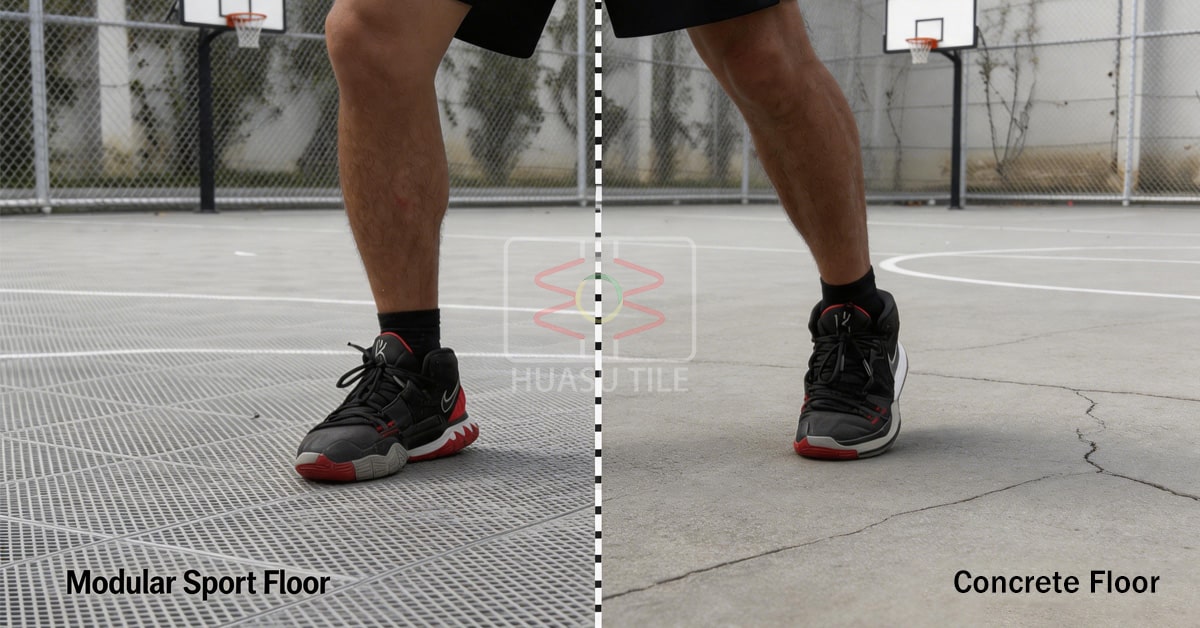
You are finally ready to build that backyard basketball court, resurface the community pickleball courts, or upgrade the school gym floor. Then the big question hits: should you go with concrete, or is a modular sport floor the better choice?
It is a decision that affects everything from player safety to long-term maintenance costs. The wrong surface can mean more injuries, higher repair bills, and a court that needs replacing far sooner than expected.
This guide gives you a complete, honest comparison of modular sport floor vs concrete floor across every dimension that matters.
Modular Sport Floor vs Concrete Floor: Key Differences at a Glance
A modular sport floor is an interlocking tile system made from high-grade polypropylene. It snaps together over a prepared base to create a suspended, shock-absorbent surface. A concrete floor is a solid poured slab that requires professional forming, reinforcement, curing, and finishing. The two perform, feel, and cost very differently.
Why Player Safety Tips the Scale Toward Modular Sport Flooring
Safety is the most important factor in any court surface. Players land hard, change direction at speed, and fall. The surface underneath determines how much impact their joints absorb.
Interlocking sport tiles offer superior shock absorption. The engineered design creates a slight “give” that cushions each footfall. Properly designed modular tile systems reduce impact forces that contribute to shin splints, stress fractures, and long-term joint damage.
Concrete offers near-zero shock absorption. Every jump landing transmits directly into the player’s ankles, knees, and lower back. A fall on concrete carries significantly higher risk of abrasion and injury.
Surface friction also differs. Quality modular tiles provide consistent grip whether the court is dry or slightly damp. Concrete becomes dangerously slippery when wet and can cause abrasive burns on exposed skin.
Total Cost of Ownership: Concrete vs Modular Floor
This is where many buyers make an expensive mistake. They look at initial costs and choose concrete because it appears cheaper. But the real math tells a different story.
Initial Installation Costs
A concrete court with acrylic sports coating, color, and game lines can run $12,000 to $25,000 or more for a regulation half-court. That does not include the crack repairs and recoating you will need every few years.
A modular sport floor for the same size court typically costs $5 to $8 per square foot. A standard half-court basketball installation runs $5,000 to $8,000 for the tiles themselves. Base preparation is often simpler, meaning lower site work costs.
Long-Term Maintenance Costs
Concrete cracks, stains, and spalls. The surface coating wears off and needs recoating every 2 to 4 years at $1,000 to $3,000 per application. Cracks require patching and sealing. Over a 15-year period, a concrete court can easily double in total cost.
Modular tiles require almost no maintenance. Individual damaged tiles can be replaced in minutes without tools. No painting, no sealing, no crack repair. A rinse with a garden hose is all most installations ever need.
Water Drainage and All-Weather Performance
This matters enormously for outdoor courts. A properly installed modular sport floor drains water through the tile gaps and the open structure beneath. The court is playable within minutes after rain stops.
Concrete suffers from ponding. Even with a slight slope, concrete surfaces develop low spots where water collects for hours or days. In colder climates, trapped water freezes and expands, widening cracks.
Surface temperature is another real concern. Dark concrete can reach 140°F on a hot summer day. Quality modular tiles reflect more heat and allow air circulation underneath, keeping the surface measurably cooler.
DIY Installation: The Practical Advantage of Modular Sport Floor
Installing concrete is not a weekend DIY project. It requires excavation, rebar, pouring, finishing, 7 days of curing, and coating application. You need concrete trucks, finishers, and often permits.
Installing modular sport tiles is within reach of an average handy homeowner. The tiles snap together over a prepared base. A standard half-court can be installed in one to two days with two people. No wet concrete, no heavy equipment, no curing time. Play immediately.
This DIY accessibility alone makes modular sport flooring the preferred choice for homeowners, schools, and community organizations.
Customization: Color, Court Lines, and Multi-Sport Versatility
Concrete offers limited customization. You can choose grey or colored paint and lines for a single sport. Modular sport floors let you mix tile colors to create custom designs, team logos, and school colors built directly into the floor. Different game lines can be integrated using contrasting tile colors, making true multi-sport courts easy to build.
Huasutile offers court design services that let you visualize your custom layout before you order a single tile. Whether you need basketball markings, pickleball kitchen lines, or a combination layout, modular tiles make it possible.
Concrete is strong but brittle. Under constant stress and freeze-thaw cycles, concrete develops cracks that widen over time. Modular tiles flex under load rather than crack. The polypropylene material is impact-resistant and UV-stabilized. A quality modular sport floor lasts 15 to 20 years with minimal maintenance. Individual tiles can be swapped, giving the floor an indefinite lifespan.
Common Myths
Myth: Modular tiles feel like plastic. Fact: Quality tiles are engineered with structural underside patterns that create a firm, stable feel with subtle shock absorption.
Myth: Tiles shift during play. Fact: Professional interlocking systems form a unified surface that does not separate or buckle during normal use.
Myth: They cannot support heavy equipment. Fact: Properly installed tiles can support vehicles, bleachers, and equipment. Load distributes across the locked tile matrix.
Which Surface Is Right for You?
Choose concrete if: You are building a covered indoor court with climate control, you need a permanent foundation for a structure built over the court, or professional installation is easily accessible.
Choose modular sport flooring if: You want the best player safety, a playable court immediately after installation, customizable colors and multi-sport layouts, DIY-friendly installation, low lifetime costs, or the ability to relocate the court in the future.
The modular sport floor vs concrete floor decision comes down to long-term value. Concrete may have a lower upfront appearance, but modular sport flooring delivers better safety, vastly lower maintenance, greater customization, and superior playability. For most homeowners, schools, and communities building an outdoor court today, modular sport flooring is the smarter, safer choice.
Next Step: Ready to build your court? Contact the Huasutile team for a free consultation. Tell us your court dimensions, preferred sports, and colors — and we will help you design the perfect modular sport floor.