TPE — thermoplastic elastomer — is a material that behaves like rubber but processes like plastic. It is a blend of hard plastic and soft rubber phases, giving it properties that neither material achieves alone.
Unlike traditional rubber, TPE does not require vulcanization (a chemical curing process). This means it can be injection-molded, recycled, and remolded — just like a thermoplastic. But when you touch it, it feels and flexes like rubber.
TPE vs. Rubber: Why It Matters for Sport Flooring
Traditional rubber sport surfaces — poured rubber or rubber tile — have been used for decades. But rubber has well-known limitations outdoors: it absorbs water, cracks under prolonged UV exposure, and develops a characteristic odor, especially when made from recycled tire crumb.
TPE solves each of these problems:
Property
TPE
Traditional Rubber
UV resistance
Good — UV stabilizers can be added
Poor — cracks within 2-5 years outdoors
Moisture resistance
Excellent — non-porous
Poor — absorbs water, promotes mold
Odor
None — no sulfur or vulcanization byproducts
Strong rubber smell, especially when hot
Recyclability
Fully recyclable — can be remolded
Limited — vulcanized rubber cannot be remelted
Elasticity retention
Consistent across temperature range
Hardens in cold, softens in heat
Weight
Lighter than rubber
Heavy
How TPE Is Used in Sport Court Tiles
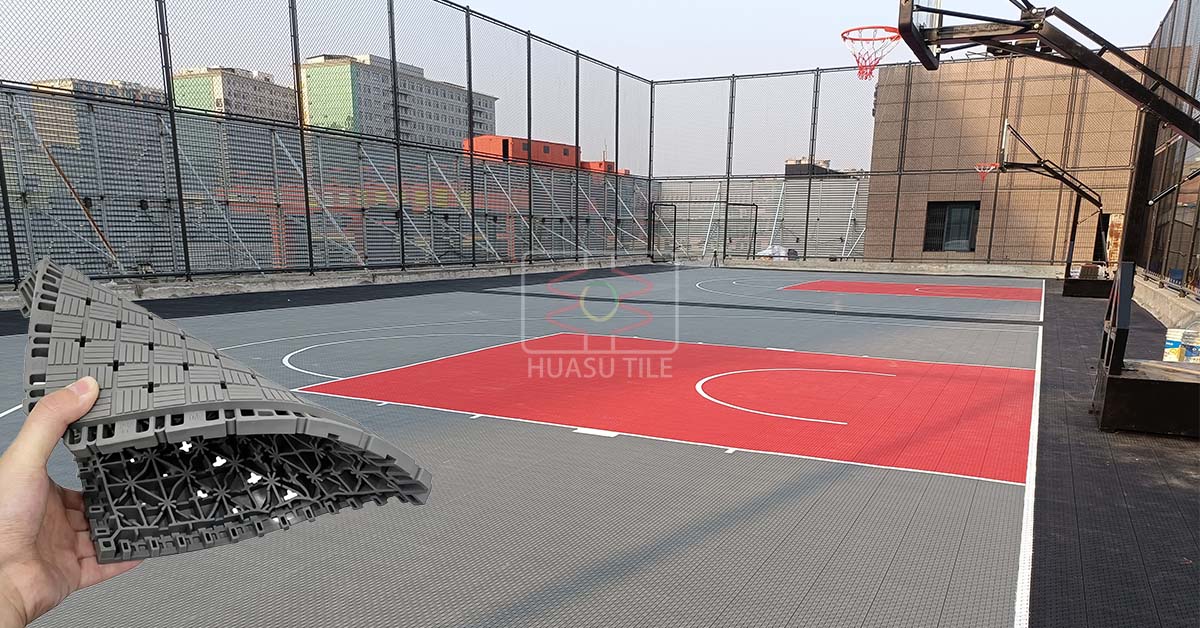
In interlocking sport court tiles, TPE serves a specific function: shock absorption. The rigid PP base provides structure, bounce, and stability. Small TPE pads are molded into the underside of each tile to absorb landing impact.
This hybrid approach — rigid PP body + elastic TPE pads — gives the best of both worlds. The ball bounces predictably off the PP surface, while the player’s joints are protected by the TPE cushion layer beneath. A full-rubber surface dampens the ball bounce; a pure PP tile with no TPE pads offers no impact protection. The PP+TPE combination avoids both extremes.
TPE Performance Metrics
– Impact force reduction: 40-70% depending on pad density and thickness
– Temperature range: -30°C to 80°C without significant property change
– Compression set: <25% after 22 hours at 70°C (resists permanent deformation)
– Rebound resilience: 40-60% (enough to absorb impact without feeling dead)
TPE Cushion Pad Tiles for Sport Courts
For buyers who want the joint protection of a cushioned surface without the drawbacks of full-rubber flooring, Huasutile offers interlocking tiles with integrated TPE cushion pads.
Each tile combines a rigid virgin PP base for structural performance with specifically engineered TPE pads on the underside. The pad count and placement vary by product line to match different sport requirements and price points.